
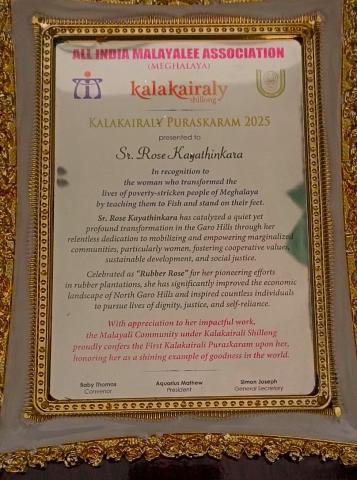
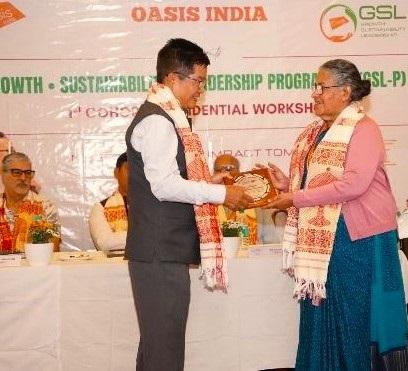
Award for Transformative Leadership in Meghalaya, North East India
Sister Rose Kayathinkara grew up in Kerala in South India and, after a visit at the age of eight to the Society’s Immaculate Heart of Mary Hospital, Bharananganam, she knew that she wanted to be a Medical Mission Sister. After professing her first vows, she was sent to Delhi to study radiography and, on completion of her studies, she set up the X-ray department in Mundakayam Medical Trust Hospital, Kerala, and continued to work there for seven years. Attending a socio-political economic seminar in 1974 was a turning point in her life because she was made aware that in India, 80% of people lived below poverty line. This influenced her to take up further studies in social work and she moved to work among the tribal peoples of Meghalaya in 1977, where the level of poverty in communities came as a shock. She began her mission activities in the villages, where there was little infrastructure, no vehicles and no electricity. For seven years, as soon as darkness fell, she relied on light from kerosene lamps, like other villagers did. She took lessons in the local Garo language and started setting up small, creative initiatives, designed to empower marginalised tribal women through weaving and assistance with chicken and pig rearing. She also provided them with lessons in adult literacy and started non-formal primary schools in the villages. Then unexpectedly, inspiration came from her father, who told her brother-in-law that earning a living from planting rubber, like he did, would bring far greater gain than working in a bank.
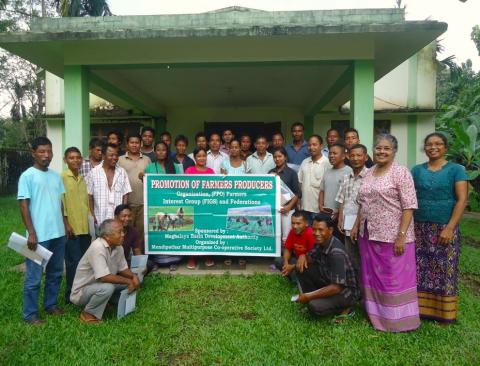
In the Garo Hills in Mendipathar, Sister Rose quickly turned to the Rubber Board of India for advice, hearing that it was looking for good people to expand rubber planting in the region. She began involving smallholder farmers in the cultivation of rubber, seeing how they were receiving few returns on their produce despite their hard work. Exploited again and again by middle men and money lenders, they faced rising debts and despair. By 1998, the Mendipathar Multipurpose Cooperative Society was set up and registered by Sister Rose, giving it legal status and a ‘multi-purpose’ focus that, she explains, leaves wide scope for its activities.
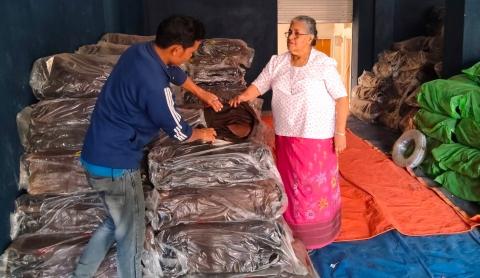
Sister Rose chose the cooperative model, realising that if loans were given to the farmers to help lift them out of poverty, they were likely to disappear with the money and never be seen again. Working together within a cooperative system, farmers, who became the cooperative’s members, were encouraged to put something in and, in turn, got something out. Any surplus made after all the costs of rubber production were covered was shared between the membership or could be reinvested back into the co-operative. Using this type of ‘dividend’ system, quickly, the farmers saw the financial return on their cultivation of rubber increase from 12 rupees to 35 rupees. Today, members continue to democratically own and control their cooperative, electing board members who serve a five-year term of office. Through cutting out the need for the middle man and the money lender, Sister Rose is delighted to report that currently, the Society in Mendipathar gives a yearly dividend of its profit to 265 members. Its annual turnover is now valued at 23 crores - one crore being equivalent to 10,000,000 rupees (approximately £81,166) - which is a quite outstanding result.
For the future, to help the cooperative to grow, as in the video interview by Prashant Pal of PURE India Trust that can be viewed opposite, it is suggested that Sister Rose might benefit from use of social media to promote, even more widely, what she is doing. For the future, she is also keen to attract support from local companies in the form of Corporate Social Responsibility (commonly known as CSR). Whilst there are quite a number of employees now working in the cooperative, she notes that one of the biggest challenges is nurturing leadership among the local population.
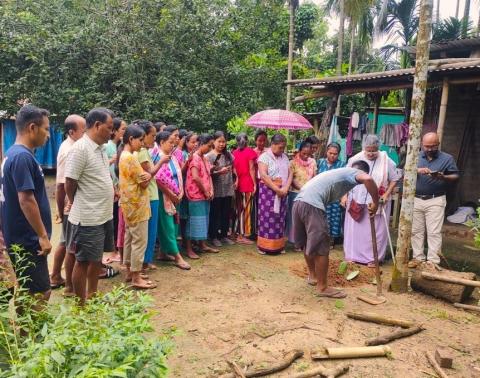
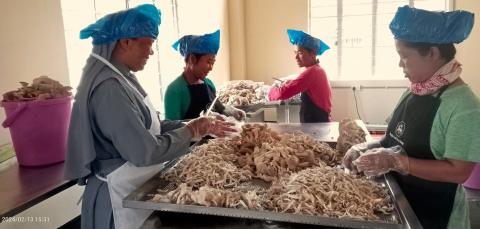
Under her personal leadership over fifty years, through its five flourishing branches, Mendipathar Multipurpose Cooperative Society has ushered a silent economic revolution in Garo Hills, transforming the lives of local people marketing rubber, black pepper, turmeric, corn, mucuna beans and other farm produce by giving them much more reasonable prices for their produce. Local women are engaged in mushroom cultivation and, post Covid-19, members have been exploring growing vanilla and cocoa, too.
Sister Rose has been honoured for her work at national as well as local level. Indeed, the Government of Meghalaya has recognised the success of the Mendipathar Multipurpose Cooperative Society and is very supportive of it, while the model itself has been replicated widely. Most recently, she received the Award for Transformative Leadership in recognition of her outstanding contribution to the economic empowerment of farmers and women through sustainable livelihoods and cooperative development in Meghalaya.' This prestigious award was presented by OASIS India at Guwahati, Assam, on 11 February 2026.
Otherwise, Sister Rose encourages all those with an interest in creating a cooperative to start small and simple and be genuine. You don’t need a big building, just vision, to become successful, she says. From her personal experience, "The viability of the cooperative is based on the sustainable use of natural resources like land, water and agricultural biodiversity, including plants and animals. Interdependence and networking are needed to bring social changes and transformation of the society".
Many congratulations on your well-deserved Award, Sister Rose - to add to the others!